
Master of Arts in Physics
2024
University of California Santa Barbara
Santa Barbara, CA

Master of Arts in Physics
2024
University of California Santa Barbara
Santa Barbara, CA

Bachelor of Science in Materials Science and Engineering
2015-2020
University of Florida
Gainesville, FL

Bachelor of Science in Materials Science and Engineering
2015-2020
University of Florida
Gainesville, FL

Researcher
Summer 2018
University of Chicago
Chicago, IL
Built production Machine Learning system detecting rare events (<0.1% prevalence) in terabyte-scale datasets
Built production Machine Learning system detecting rare events (<0.1% prevalence) in terabyte-scale datasets
Built production Machine Learning system detecting rare events (<0.1% prevalence) in terabyte-scale datasets
Researcher
Summer 2018
University of Chicago
Chicago, IL
Built production Machine Learning system detecting rare events (<0.1% prevalence) in terabyte-scale datasets
Built production Machine Learning system detecting rare events (<0.1% prevalence) in terabyte-scale datasets
Built production Machine Learning system detecting rare events (<0.1% prevalence) in terabyte-scale datasets

Researcher
Summer 2020
Stanford
Stanford, CA
Built production Machine Learning system detecting rare events (<0.1% prevalence) in terabyte-scale datasets
Built production Machine Learning system detecting rare events (<0.1% prevalence) in terabyte-scale datasets
Built production Machine Learning system detecting rare events (<0.1% prevalence) in terabyte-scale datasets

Researcher
Summer 2020
Stanford
Stanford, CA
Built production Machine Learning system detecting rare events (<0.1% prevalence) in terabyte-scale datasets
Built production Machine Learning system detecting rare events (<0.1% prevalence) in terabyte-scale datasets
Built production Machine Learning system detecting rare events (<0.1% prevalence) in terabyte-scale datasets
Anomaly Detection
Jan 2023 - Present
CMS collaboration
After decades of searching for specific new physics signatures with no discoveries, the field is shifting toward model-agnostic anomaly detection—casting a wider net to find anything unusual lurking in our data
Collaborating with theoretical physicist Nathaniel Craig to incorporate novel topological descriptions of particle collisions, allowing us to characterize what makes an event "stand out" in a mathematically rigorous wa
Using generative AI to create synthetic background events, giving us a template of "normal" against which rare signal events become visible—even when signal contamination is less than 1%
Published our methodology in Physical Review D and presented at ML4HEP and CMS collaboration meetings
Currently applying this approach to search for exotic dimuon resonances in the full CMS dataset
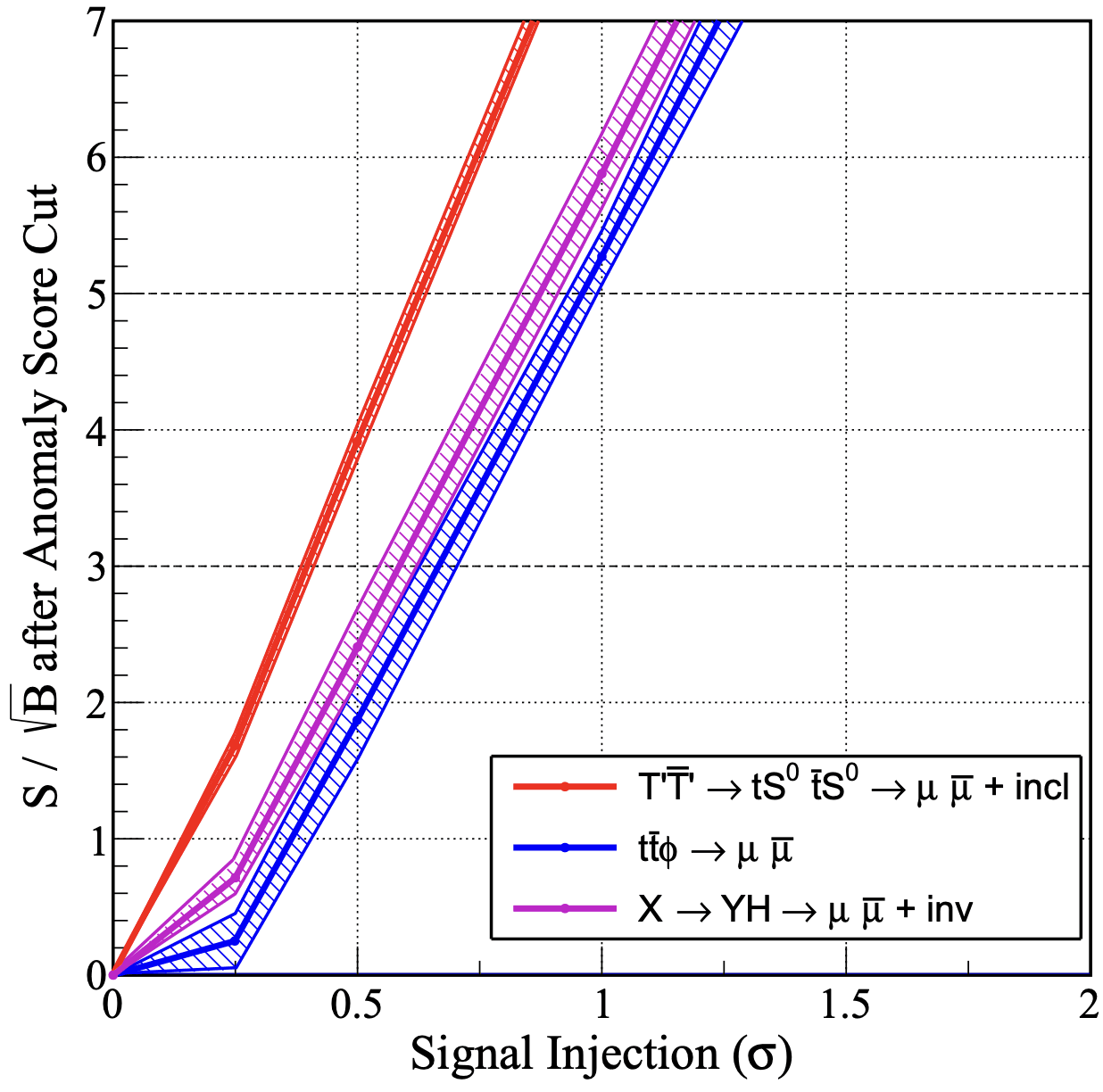
Key result from publication showing that 5σ discoveries can be made with significantly less Signal being present
Anomaly Detection
Jan 2023 - Present
CMS collaboration
After decades of searching for specific new physics signatures with no discoveries, the field is shifting toward model-agnostic anomaly detection—casting a wider net to find anything unusual lurking in our data
Collaborating with theoretical physicist Nathaniel Craig to incorporate novel topological descriptions of particle collisions, allowing us to characterize what makes an event "stand out" in a mathematically rigorous wa
Using generative AI to create synthetic background events, giving us a template of "normal" against which rare signal events become visible—even when signal contamination is less than 1%
Published our methodology in Physical Review D and presented at ML4HEP and CMS collaboration meetings
Currently applying this approach to search for exotic dimuon resonances in the full CMS dataset
Key result from publication showing that 5σ discoveries can be made with significantly less Signal being present
Earth as a Dark Matter Source
July 22 - Present
CMS Collaboration
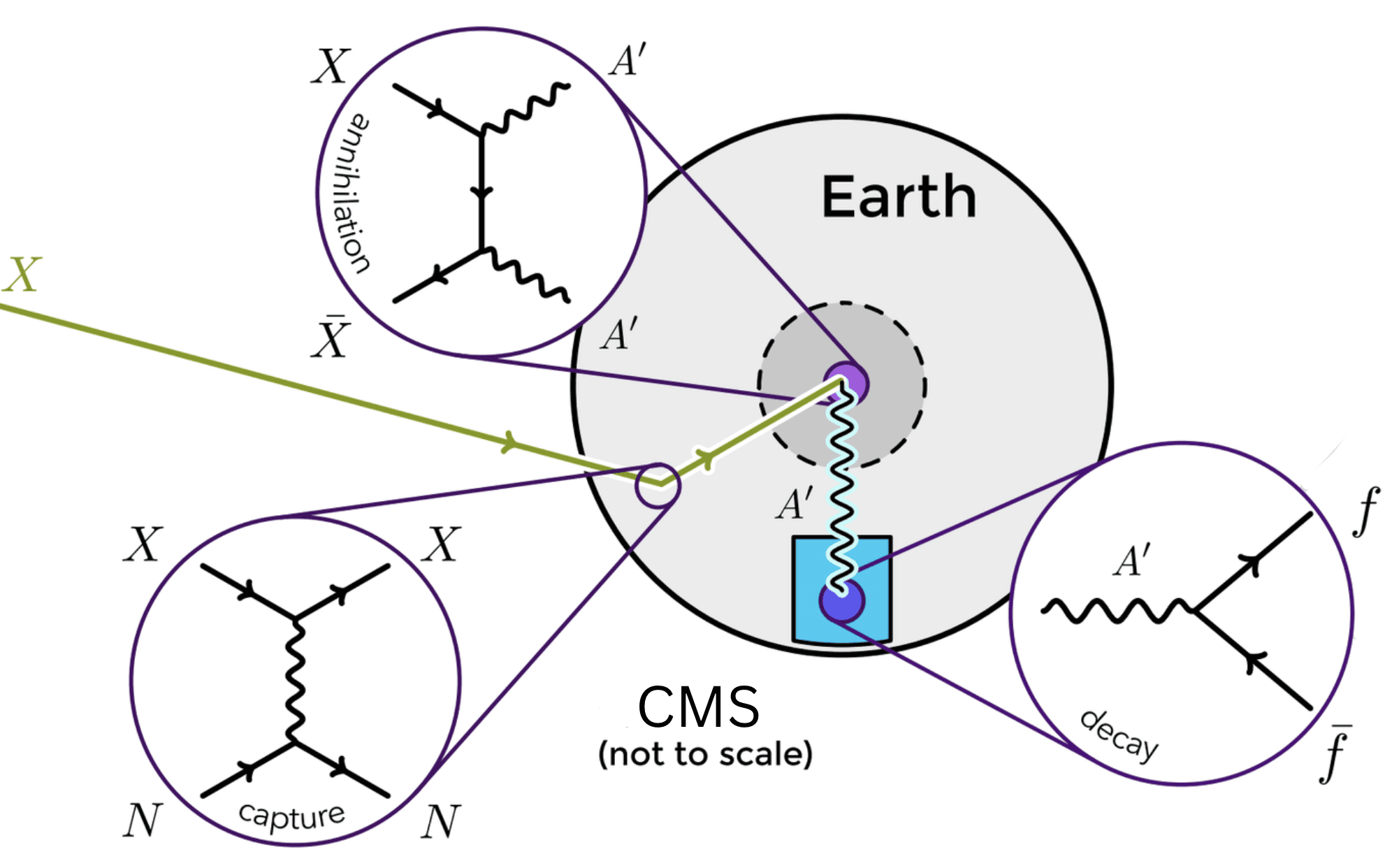
Investigating a counterintuitive dark matter signal: particles that become gravitationally trapped at Earth's center, occasionally annihilate, and send muons traveling upward through the planet
The CMS detector was designed to study downward-traveling cosmic rays—can we repurpose it to catch upward-traveling dark matter signals?
Establishing baseline trigger efficiencies and conducting feasibility studies to determine if CMS can identify this unconventional signature
Exploring new parameter space by leveraging Earth itself as a dark matter collector
A visualization of Dark Matter becoming trapped, annhilating, and being detected by the CMS detector
Earth as a Dark Matter Source
July 22 - Present
CMS Collaboration
Investigating a counterintuitive dark matter signal: particles that become gravitationally trapped at Earth's center, occasionally annihilate, and send muons traveling upward through the planet
The CMS detector was designed to study downward-traveling cosmic rays—can we repurpose it to catch upward-traveling dark matter signals?
Establishing baseline trigger efficiencies and conducting feasibility studies to determine if CMS can identify this unconventional signature
Exploring new parameter space by leveraging Earth itself as a dark matter collector
A visualization of Dark Matter becoming trapped, annhilating, and being detected by the CMS detector
CMS Detector Upgrade
July 21 - Present
CMS Collaboration
Rigorous quality control protocols across thousands of precision detector modules ensure reliable performance in extreme radiation environments
Enabling 40× luminosity increase unlocks sensitivity to ultra-rare processes previously beyond experimental reach
Opening discovery space for next-generation searches including inelastic dark matter and Higgs self-coupling measurements
Research group already developing analysis frameworks for new physics searches leveraging HGCAL's enhanced capabilities
Cutting-edge silicon detector technology sets foundation for future collider experiments and precision particle physics
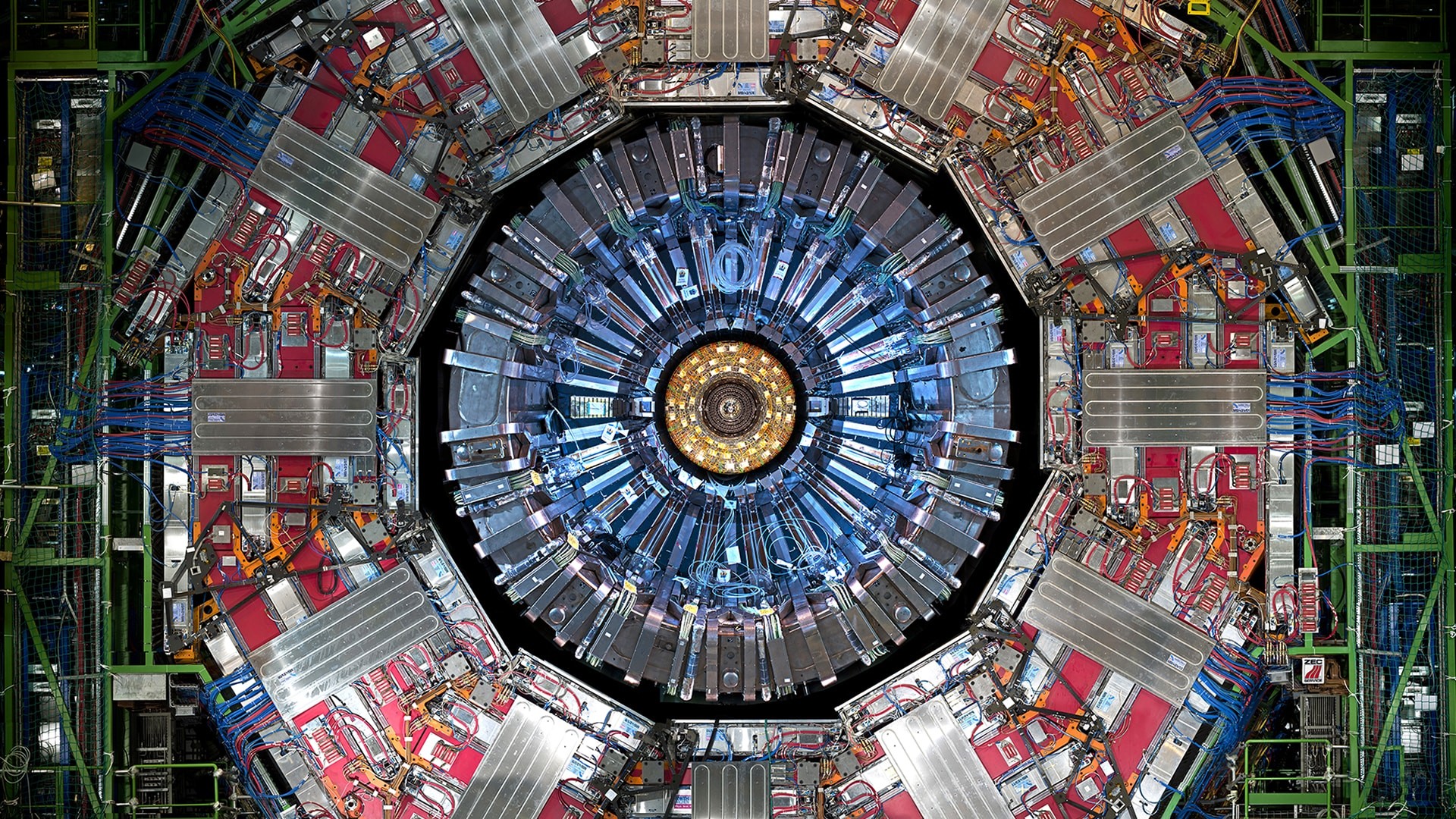
Large sections of this 14,000-ton detector will be dismantled and upgraded to handle 40× higher collision rates
CMS Detector Upgrade
July 21 - Present
CMS Collaboration
Rigorous quality control protocols across thousands of precision detector modules ensure reliable performance in extreme radiation environments
Enabling 40× luminosity increase unlocks sensitivity to ultra-rare processes previously beyond experimental reach
Opening discovery space for next-generation searches including inelastic dark matter and Higgs self-coupling measurements
Research group already developing analysis frameworks for new physics searches leveraging HGCAL's enhanced capabilities
Cutting-edge silicon detector technology sets foundation for future collider experiments and precision particle physics
Large sections of this 14,000-ton detector will be dismantled and upgraded to handle 40× higher collision rates
Light Dark Matter Experiment
Dec 21 - Present
Light Dark Matter eXperiment
Searching for MeV-GeV mass dark matter through missing-momentum signatures in electron fixed-target collisions at SLAC
Targeting 1000-fold sensitivity improvement to fully explore thermal relic dark matter scenarios
Unique capability to probe electron-DM couplings critical to thermal dark matter origin, complementing direct detection experiments
Detector design enables both invisible missing-energy searches and visible long-lived particle decay signatures
Priority Research Direction 1 from DOE's Dark Matter New Initiatives: creating and detecting dark matter particles below the proton mass

The electron beam hits a target and has a chance to produce a dark matter pair through dark bremsstrahlung
Light Dark Matter Experiment
Dec 21 - Present
Light Dark Matter eXperiment
Searching for MeV-GeV mass dark matter through missing-momentum signatures in electron fixed-target collisions at SLAC
Targeting 1000-fold sensitivity improvement to fully explore thermal relic dark matter scenarios
Unique capability to probe electron-DM couplings critical to thermal dark matter origin, complementing direct detection experiments
Detector design enables both invisible missing-energy searches and visible long-lived particle decay signatures
Priority Research Direction 1 from DOE's Dark Matter New Initiatives: creating and detecting dark matter particles below the proton mass
The electron beam hits a target and has a chance to produce a dark matter pair through dark bremsstrahlung
Research
Intro

Design Showcased
Create dynamic Framer designs with easy animations.
Scroll Effects
Enhance user experience with scroll-triggered animations.
No-Code Web Magic
Realize web development ideas without coding.
Animated Web Journey
Dive into captivating scroll animations without code.
Projects





Testimonials

Evelyn Brooks
Lead Engineer at Sigma, managed Henry directly
Having worked alongside Henry at Sigma, I've been consistently impressed by his exceptional skills as a frontend engineer. Henry's hands-on approach and dedication to building robust web and mobile applications have greatly contributed to our project's success.
Evelyn Brooks
Lead Engineer at Sigma, managed Henry directly
Having worked alongside Henry at Sigma, I've been consistently impressed by his exceptional skills as a frontend engineer. Henry's hands-on approach and dedication to building robust web and mobile applications have greatly contributed to our project's success.

Raj Patel
Junior Software Engineer at Omega, worked with Henry on the same team
Henry’s expertise has been crucial in turning our ambitious project ideas into reality at Omega. His proficiency in both front-end and back-end development ensures a seamless integration of features, delivering a user experience that's both intuitive and high-performing.
Raj Patel
Junior Software Engineer at Omega, worked with Henry on the same team
Henry’s expertise has been crucial in turning our ambitious project ideas into reality at Omega. His proficiency in both front-end and back-end development ensures a seamless integration of features, delivering a user experience that's both intuitive and high-performing.
License & Certification

Alpha Certified Developer Associate
Issued 2019
Alpha Certified Developer Associate
Issued 2019

Beta Certified Developer Associate
Issued 2023
Beta Certified Developer Associate
Issued 2023
Education
Awards
NSF Graduate Research Fellowship
Flagship national fellowship awarded to exceptional early-career researchers
2023
NSF Graduate Research Fellowship
Flagship national fellowship awarded to exceptional early-career researchers
2023
Breakthrough Prize in Fundamental Physics - Co-recpient
Recognizes those who have made profound contributions to human knowledge
2025
Breakthrough Prize in Fundamental Physics - Co-recpient
Recognizes those who have made profound contributions to human knowledge
2025
Joseph Polchinski Fellowship
Annual fellowship for the top UCSB Particle Physics student
2021
Joseph Polchinski Fellowship
Annual fellowship for the top UCSB Particle Physics student
2021
Worster Research Fellowship
Prestigious UCSB Mentoring Fellowship given to a Graduate Student - Undergraduate pair
2022
Worster Research Fellowship
Prestigious UCSB Mentoring Fellowship given to a Graduate Student - Undergraduate pair
2022
Education and Experience
Ph.D in Physics
2021-2026
University of California Santa Barbara
Santa Barbara, CA

M.A in Physics
2023
University of California Santa Barbara

Researcher
2020
Stanford
Deep-Sea Atomic Clock Design for Geological Mapping and Exploration
Researcher
2018
University of Chicago
Neutrino Detector Development for investigating Coherent Elastic Neutrino-Nucleus Scattering
Collaborator
2021-present
Light Dark Matter eXperiment
Deployed and optimized Graph Convolutional Network models (ParticleNet) for particle classification on sparse datasets, while maintaining production C++ software infrastructure
Collaborator
2023-present
Compact Muon Solenoid
Compact Muon Solenoid Experiment: Developed model-agnostic anomaly detection system using generative ML models to scan terabyte-scale datasets for unexpected signals. Separately conducted targeted search for dark matter produced in Earth's core using optimized signal extraction and statistical analysis
B.S in Materials Science and Engineering
2015-2020
University of Florida
Undergraduate Researcher
2016-2019
University of Florida
Investigation and Development of Multi-Use Ice-Phobic Polymers
Education and Experience
Ph.D. in Physics
2021-2026
University of California Santa Barbara
I search for extremely rare events in massive datasets using machine learning, artificial intelligence, statistical analysis, and scalable production pipelines applicable to fraud detection, risk modeling, and anomaly detection
M.A in Physics
2023
University of California Santa Barbara
Researcher
2020
Stanford
Deep-Sea Atomic Clock Design for Geological Mapping and Exploration
Researcher
2018
University of Chicago
Neutrino Detector Development for investigating Coherent Elastic Neutrino-Nucleus Scattering
Collaborator
2021-present
Light Dark Matter eXperiment
Deployed and optimized Graph Convolutional Network models (ParticleNet) for particle classification on sparse datasets, while maintaining production C++ software infrastructure
Collaborator
2023-present
Compact Muon Solenoid
Compact Muon Solenoid Experiment: Developed model-agnostic anomaly detection system using generative ML models to scan terabyte-scale datasets for unexpected signals. Separately conducted targeted search for dark matter produced in Earth's core using optimized signal extraction and statistical analysis
B.S in Materials Science and Engineering
2015-2020
University of Florida
Undergraduate Researcher
2016-2019
University of Florida
Investigation and Development of Multi-Use Ice-Phobic Polymers

NSF Graduate Research Fellow
July 21' - Present
University of California Santa Barbara
Santa, Barbara CA
Built production Machine Learning system detecting rare events (<0.1% prevalence) in terabyte-scale datasets
Built production Machine Learning system detecting rare events (<0.1% prevalence) in terabyte-scale datasets
Built production Machine Learning system detecting rare events (<0.1% prevalence) in terabyte-scale datasets
AI and Machine Learning
2021 - Present
UC Santa Barbara
NSF Graduate Research Fellow
Built production Machine Learning system detecting rare events (<0.1% prevalence) in terabyte-scale datasets
Generative models (Flow Matching) achieving breakthrough detection on previously invisible patterns
Deployed Graph Convolutional Networks with >99.99% classification accuracy
75% performance improvement through custom architecture and feature engineering
NSF Graduate Research Fellow
July 21' - Present
University of California Santa Barbara
Santa, Barbara CA
Built production Machine Learning system detecting rare events (<0.1% prevalence) in terabyte-scale datasets
Built production Machine Learning system detecting rare events (<0.1% prevalence) in terabyte-scale datasets
Built production Machine Learning system detecting rare events (<0.1% prevalence) in terabyte-scale datasets
Experience
Research Skills
Software Development & Maintenance
2021 - Present
UC Santa Barbara
NSF Graduate Research Fellow
Established Git workflows and code review protocols for 10+ person distributed team
Debugged and maintained critical C++ components in large collaborative codebase
Collaborated on shared codebase with distributed team using Git workflows
Software Development & Maintenance
2021 - Present
UC Santa Barbara
NSF Graduate Research Fellow
Established Git workflows and code review protocols for 10+ person distributed team
Debugged and maintained critical C++ components in large collaborative codebase
Collaborated on shared codebase with distributed team using Git workflows
Production Pipelines & Quality Control
2021 - Present
UC Santa Barbara
NSF Graduate Research Fellow
Scalable ETL pipelines processing 10+ TB datasets with 10,000× compression ratios
Automated orchestration of 1000+ parallel computing jobs across distributed clusters
Implemented rigorous validation protocols ensuring robust model performance
Production Pipelines & Quality Control
2021 - Present
UC Santa Barbara
NSF Graduate Research Fellow
Scalable ETL pipelines processing 10+ TB datasets with 10,000× compression ratios
Automated orchestration of 1000+ parallel computing jobs across distributed clusters
Implemented rigorous validation protocols ensuring robust model performance
Ph.D. candidate in Physics with NSF Graduate Research Fellowship, specializing in machine learning systems, statistical modeling, and large-scale data analysis. Expert in developing production-scale ML pipelines, novel algorithms for anomaly detection and pattern recognition, and distributed computing infrastructure. Strong track record of research, software engineering, and technical leadership with 300+ peer-reviewed publications and 3600+ citations.
Ph.D. candidate in Physics with NSF Graduate Research Fellowship, specializing in machine learning systems, statistical modeling, and large-scale data analysis. Expert in developing production-scale ML pipelines, novel algorithms for anomaly detection and pattern recognition, and distributed computing infrastructure. Strong track record of research, software engineering, and technical leadership with 300+ peer-reviewed publications and 3600+ citations.
Introduction
Public speaking (Under Construction)
The Light Dark Matter eXperiment
Santa Barbara Astronomy Club
October 2024
Gave an overview of the LDMX collaboration and my own work in the search for Dark Matter
Citations: Earth as DM Image: https://arxiv.org/pdf/1509.07525
Background Video: https://www.quantamagazine.org/new-particle-collision-math-may-offer-quantum-clues-20200820/: